
Introduction: Product Management at the Epicenter of Modern Growth
Product Management has evolved from a coordination role into the heartbeat of organizational strategy. In an economy defined by lean budgets, hyper-competition, and relentless innovation, Product Managers are no longer just building features, they’re designing the growth engine itself.
The era of Product-Led Growth (PLG) has rewritten the rules. Acquisition, retention, and expansion are now owned by the product, not just marketing or sales. And yet, even as PLG becomes the dominant growth philosophy, many organizations struggle to align culture, data, and execution around it.
This article explores the latest trends shaping the product-led industry, the challenges teams face, and how PMs can overcome the odds to ship products that truly move the needle.
The Product-Led Movement: Where We Stand Now
Just a few years ago, product management was seen as a blend of business analysis and project oversight. Today, it’s a strategic growth function, the driver of user adoption, monetization, and innovation.
Trend 1: The Product as the Primary Growth Channel
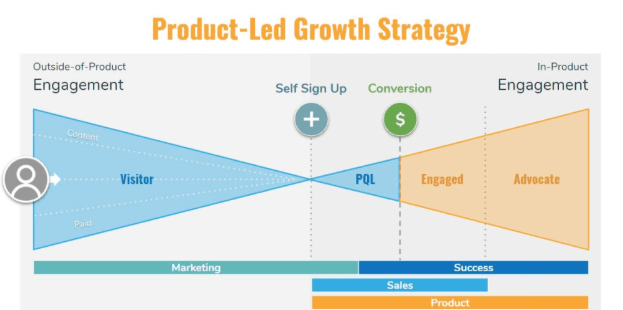
In PLG, your product is your marketing. Companies like Slack, Figma, and Notion didn’t scale through massive ad budgets, they built products that sold themselves. According to ProductLed’s 2024 report, 72% of SaaS companies now identify as product-led.
In this model, PMs increasingly design self-serve onboarding that converts without sales calls, craft “aha moments” that compress time-to-value, and embed growth loops, think viral sharing, network effects, and seamless in-product upgrades, so the product compounds its own momentum. The takeaway? The modern PM is not just a strategist but a growth architect.
Trend 2: Data Literacy Is the New Superpower
A decade ago, “data-driven” meant checking Google Analytics. Today, it means designing end-to-end experiments, running A/B tests at scale, and tying behavioral signals to business outcomes. Modern PMs are fluent in Mixpanel, Amplitude, SQL, and cohort analysis; they aren’t waiting for insights, they’re generating them. The challenge is data fragmentation: as tools multiply, weaving product analytics, customer feedback, and revenue data into a single story has become the PM’s biggest analytical headache.
Trend 3: AI-Augmented Product Management
Artificial Intelligence isn’t just powering user experiences, it’s transforming how PMs work. In practical terms, teams use AI models to synthesize thousands of qualitative reviews in minutes, lean on predictive analytics to flag churn before it happens, and experiment with generative design tools to draft onboarding flows in seconds. Yet there’s a line worth respecting: AI should amplify judgment, not replace it. Human-centered decision-making remains at the core of great products. As one CPO recently put it, “AI can tell you what users do, but not why they care.”

The Challenges Facing Product-Led Organizations
As the PLG model scales, so do its growing pains. Let’s unpack the three most pressing ones:
Challenge 1: Misalignment Between Growth and Product Strategy
In theory, PLG unites teams around one goal: user success. In practice, it can spark turf wars between marketing, product, and sales. PMs often feel pressured to “own growth” without real influence over pricing, funnel messaging, or customer success metrics. The result is confused accountability and disjointed experiments.
Solution: Reframe product growth as shared ownership. Establish a single slate of KPIs, activation, retention, and expansion revenue that blends marketing and product impact, and institutionalize a weekly “growth council” where product, data, and sales leaders review experiments and pipeline together.
Challenge 2: Building at the Speed of Expectation
In a world where users expect real-time everything, shipping velocity is a competitive weapon. Yet PMs are frequently buried under stakeholder debates, competing priorities, and analysis paralysis.
Solution: Revisit your definition of done. Use an MVP-to-MLP mindset so you ship focused, high-value experiences that early users genuinely love, and adopt continuous discovery habits—test small, learn fast, iterate relentlessly. In PLG companies, velocity isn’t measured by tickets closed; it’s measured by learning per sprint.
Challenge 3: Scaling Culture and Process Without Killing Agility
As startups mature into scale-ups, the biggest threat often isn’t competition, it’s bureaucracy. Process creep can smother innovation faster than bad code, and PMs find themselves in governance meetings instead of user interviews.
Solution: Create “freedom with framework.” Empower teams with guardrails rather than gates and replace top-down approvals with outcome-based accountability. When teams understand why they’re building something, they don’t need permission—they need autonomy.
The Wins: What High-Performing Product Teams Are Doing Right
Despite the noise, many product-led organizations are thriving. Here’s what they have in common:
1. They Treat User Experience as a Growth Metric
Top PLG companies connect UX directly to revenue. A smoother onboarding journey translates to higher conversion; faster load times correlate with lower churn; clearer, more transparent pricing accelerates expansion. They track user experience with the same rigor as cash flow—because in a product-led world, experience is the funnel.
2. They Democratize Data Access
Analytics is no longer an engineering bottleneck. High-performing teams put real-time data in the hands of every PM, designer, and marketer so decisions move at the pace of users. Some go further by teaching data storytelling, ensuring insights travel beyond dashboards and shape decisions in boardrooms.
3. They Build Communities, Not Just Products
Products that scale sustainably build communities around them. Notion, Figma, and Duolingo succeed because users feel like contributors, not customers. Community roadmaps, feedback loops, and public changelogs turn passive users into advocates. In 2025, community-led growth isn’t a campaign, it’s a moat.
4. They Marry AI with Human Empathy
AI optimizes; humans empathize. Winning teams use models to spot where users drop off, then pair those signals with interviews to understand why. One PLG fintech team did exactly this and lifted retention by 24%, building a culture that respects both numbers and narratives.
The New PM Playbook: How to Overcome the Odds and Ship Something Great
The modern PM’s journey isn’t linear; it’s a balancing act of vision, data, design, and resilience. Here’s a practical playbook to navigate the chaos:
Step 1: Anchor on Outcomes, Not Outputs
Shift the conversation from “what are we building?” to “what are we changing?” Define success in user behavior and business value, not feature count. For example, swap “launch onboarding v2” for “reduce time-to-first-value by 20%,” or replace “build AI chatbot” with “increase self-serve resolution by 30%.” When your team speaks the language of outcomes, prioritization becomes obvious.
Step 2: Make Discovery a Continuous Habit
The best PMs don’t schedule discovery, they live it. Embed lightweight research in every sprint, from weekly customer calls and support-ticket shadowing to daily usage analysis. To keep efforts focused, visualize problems with Opportunity Solution Trees, prioritize with RICE or ICE, and align stakeholders using a concise Problem Framing Canvas. Discovery stops being a phase and becomes the culture.
Step 3: Build a Feedback-Rich Environment
Great products are forged in candor and iteration. Encourage design critiques, retros, and peer reviews, and cultivate psychological safety so feedback becomes fuel, not fear. Rituals help: run a “Fail Friday” to learn from experiments that didn’t land, host quarterly cross-team Product Reviews, and showcase a regular “Voice of the Customer” to keep empathy in the room.
Step 4: Embrace Technical Fluency
PMs don’t have to code, but they do need to understand how technology works. Fluency in APIs, data models, and AI basics leads to sharper questions and stronger partnerships with engineering. Learn enough SQL to pull your own metrics, get comfortable reading API docs to validate integration scope, and practice prompt engineering so AI tools make you faster—not lazier. Fluency earns respect; empathy earns trust. Both earn influence.
Step 5: Prioritize Mental Agility, Not Just Frameworks
Product Management is one of tech’s toughest roles. PMs juggle ambiguity, conflicting feedback, and unrelenting deadlines. Staying grounded amid chaos is a leadership skill. Build mental agility with brief reflections at the end of each sprint (“what did I learn?”), treat setbacks as prototypes for future wins, and remember that every delay or pivot is data, not defeat. As Marty Cagan says, “It’s not your job to ship features; it’s your job to ship outcomes.”
Looking Ahead: The Future of Product-Led Leadership
As technology evolves, so does the role of the Product Manager. In 2025 and beyond, PMs will be expected to lead not only with data and design but also with ethical foresight and strategic empathy. The most forward-leaning teams will invest in AI governance that keeps machine-made decisions transparent, bring sustainability into the design brief rather than the CSR report, and treat privacy and cybersecurity as product features rather than compliance afterthoughts.
The next generation of product leaders will be systems thinkers, capable of connecting user needs, data patterns, and ethical boundaries into cohesive strategies.

Conclusion: Shipping Against the Odds
The product-led revolution has raised the bar. Users expect more. Teams move faster. Competition never sleeps. But amidst the chaos lies the beauty of Product Management, the craft of turning uncertainty into impact. Whether you’re a PM at a scrappy startup or a Fortune 500 scale-up, your role is to keep building bridges between data and emotion, vision and execution, teams and users. Because every feature shipped under pressure, every pivot made with conviction, and every insight that turns confusion into clarity is proof of what Product Management truly represents: courage, curiosity, and the relentless pursuit of something great.
 Hamza Mobeen